Club Calma

A cruising sailboat club · French flag · Costa Brava

Scroll

A French-flagged owner-version Beneteau 40, shared by six couples who keep coming back, season after season, on the Costa Brava.

Request an introduction
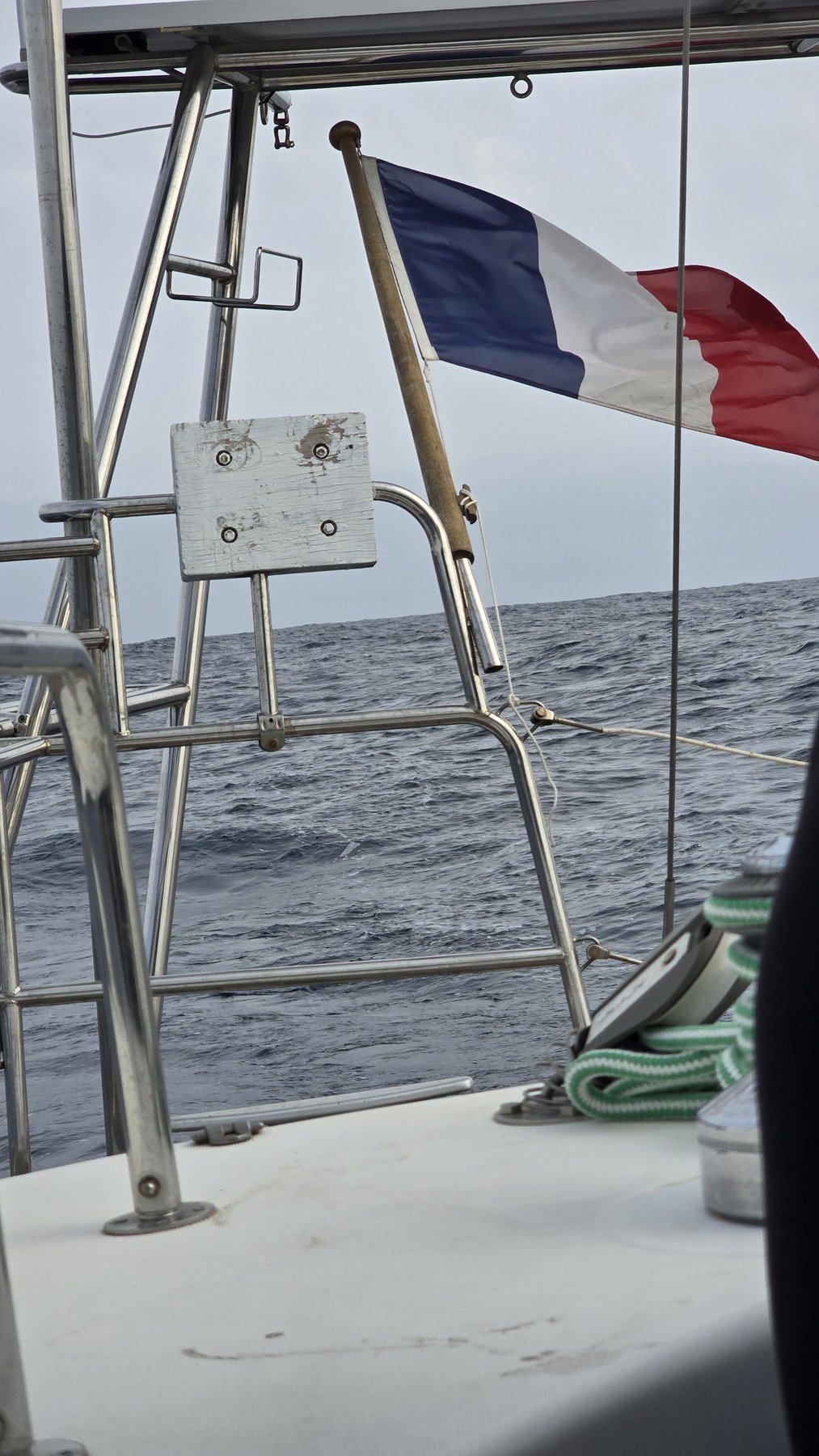
French flag at the Calma's stern, Sète registration
French flag at the stern — registered in Sète.

A French sailing club on Spain's Costa Brava, for six couples.

French flag · French company · French paperwork and VAT · A rare format on the Spanish Mediterranean, set up for francophone-friendly cruisers and their friends.

Flag French — Sète
Company CALMA S.A.S.U. — Paris
Home port Palamós, Costa Brava
Members Six couples francophone-friendly
— 01 / The boat

Beneteau Oceanis 40 CC Calma

A boat for cruising in couples — center cockpit, full-width owner stateroom aft, an open="open" and bright saloon, and a large galley. Built for two adults who want space, with the option to invite another couple or close family for the week.

ModelOceanis 40 CC
LOA40 ft / 12.30 m
Beam13 ft / 3.95 m
Year1998 — refit 2025–26
EngineVolvo MD22 — 60 hp
CE designA — ocean
Fresh water132 gal / 500 L
Diesel46 gal / 175 L
— 02 / Accommodation

Built for couples

The Oceanis 40 CC is uncommon on the secondhand market: a true center-cockpit design, in the rarer "owner version" — that is, two real cabins, each with its own private head and shower, instead of three or four small cabins squeezed in for charter rentals.

The owner stateroom — aft cabin
Aft cabin

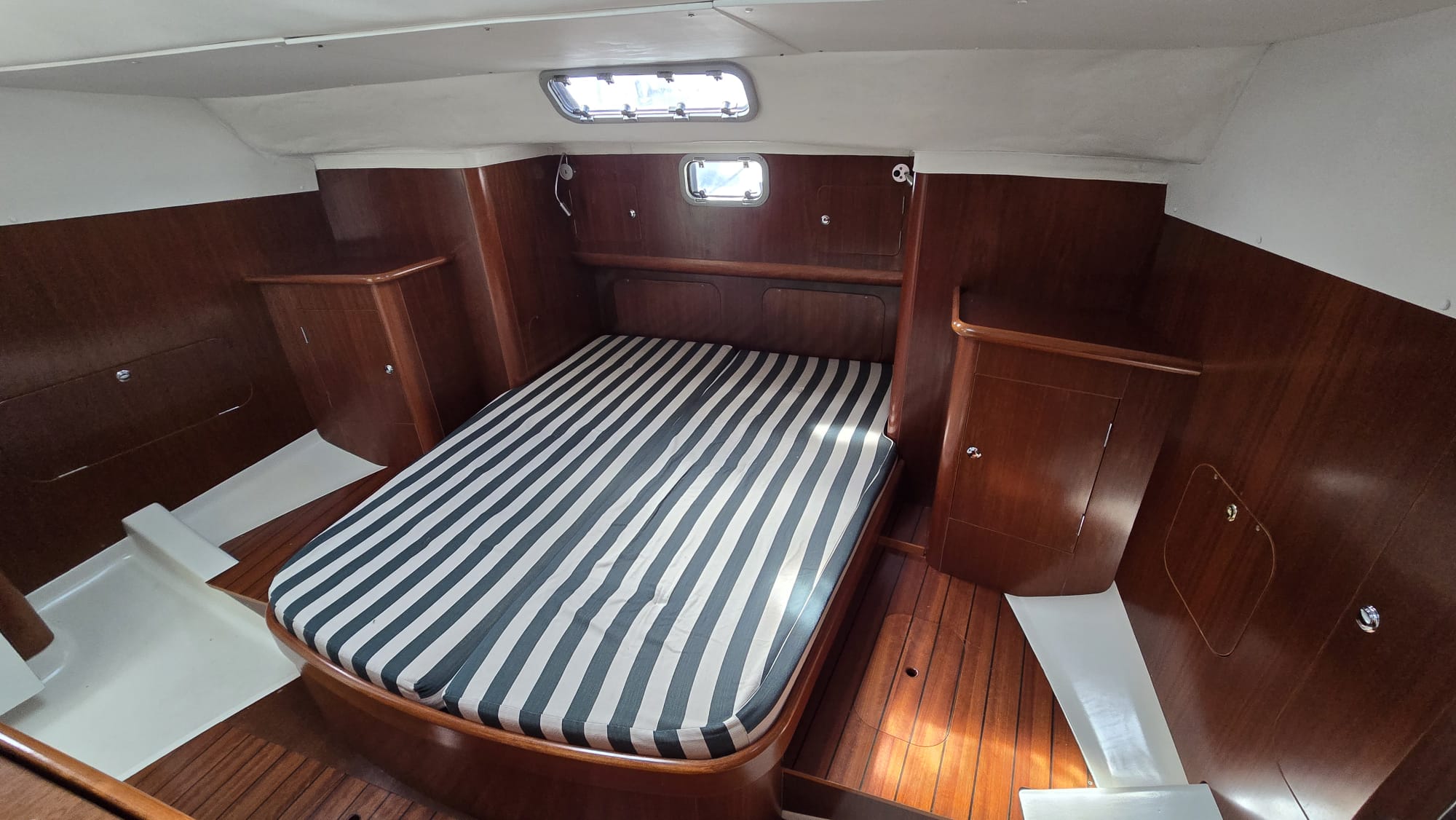
The owner stateroom

Full-width, in the stern. A 5-foot-wide queen bed, accessible from both sides — you stand up, you walk around, you each have your own side. Private head and shower in the cabin. The kind of comfort you'd expect on a 47-footer, not a 40.

  • Bed Queen, 5 ft / 150 cm wide
  • Head Private, with shower stall
  • Headroom Full standing
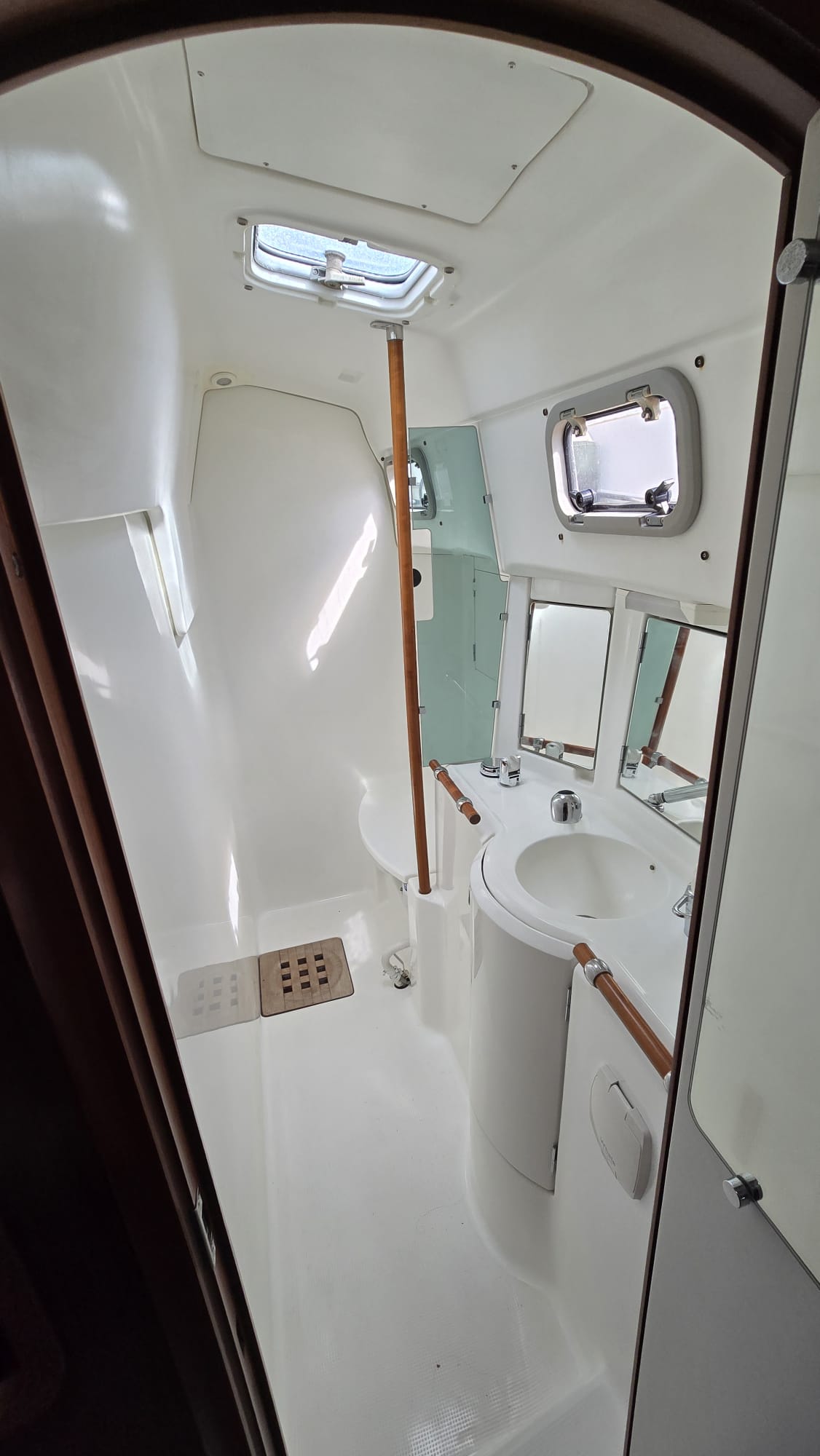
Private head and shower of the owner stateroom

The private head and shower of the owner stateroom.

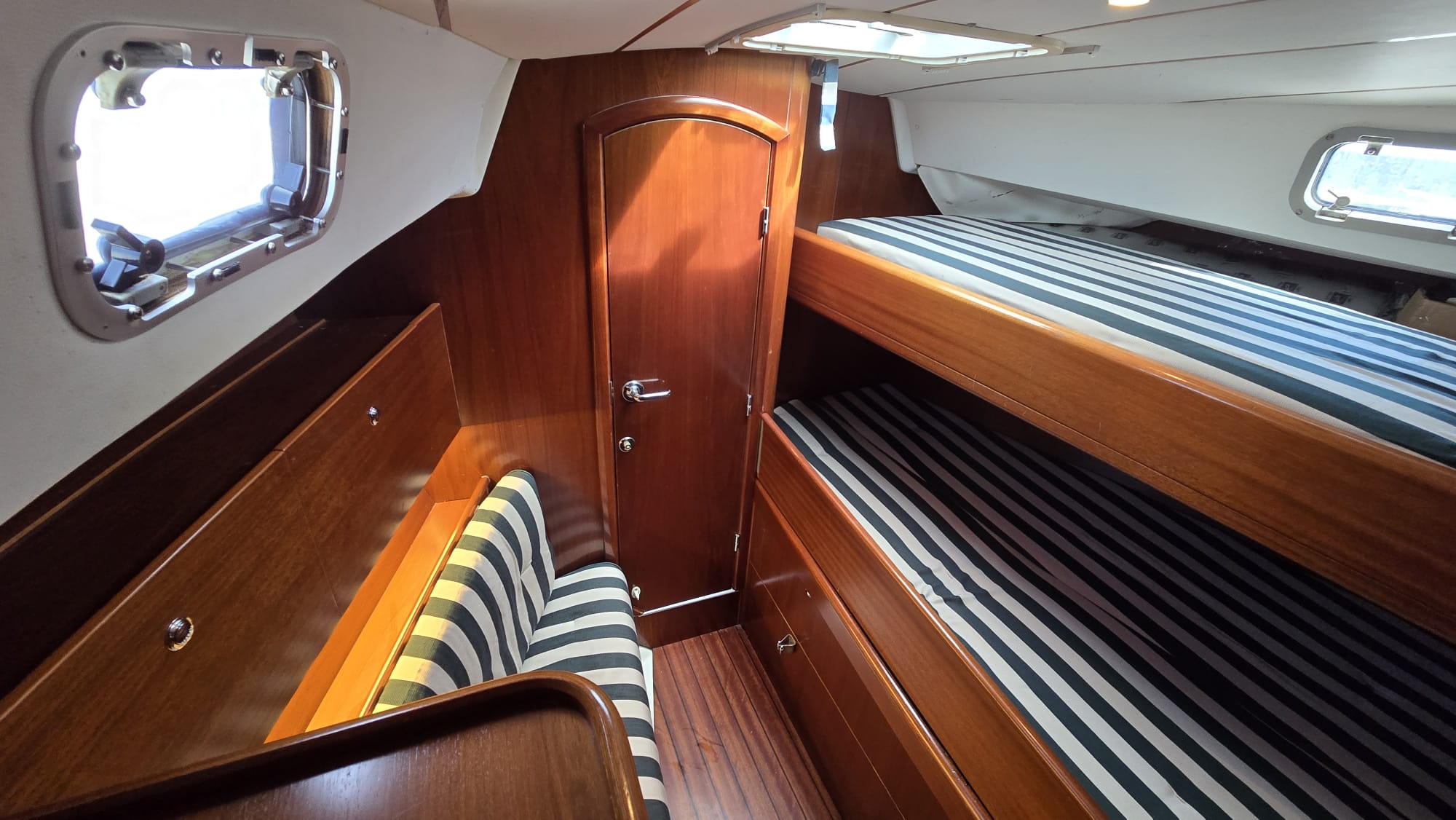
The guest stateroom — forepeak cabin
Forward cabin

The guest stateroom

Forepeak cabin with a double V-berth and an upper Pullman berth. Private head and shower, on the starboard side. A real second stateroom — for a couple of friends or a close family member, with comfort comparable to the owner side.

  • Bed Double V + upper Pullman
  • Head Private, with shower stall
  • Use Friends or family
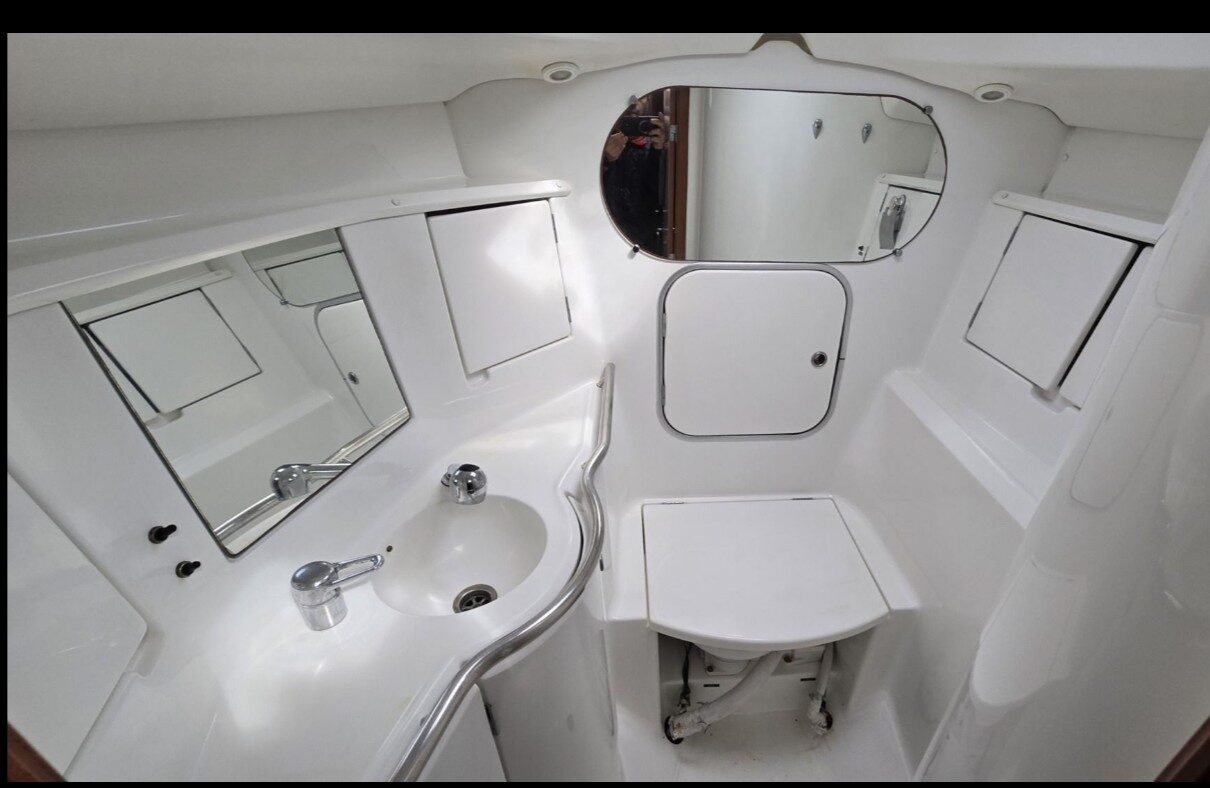
Private head and shower of the guest stateroom

The private head and shower of the guest stateroom, forward.

Two real private suites on a 40-footer — that's the signature of the Calma. An owner's boat, shared between owners.

— 02bis / On board

The living spaces

Comfort on board isn't obvious at first glance; you feel it by the third day. Galley, saloon, cockpit, sails — four rooms designed so four people coexist without bumping into each other, and two can cast off without complication.

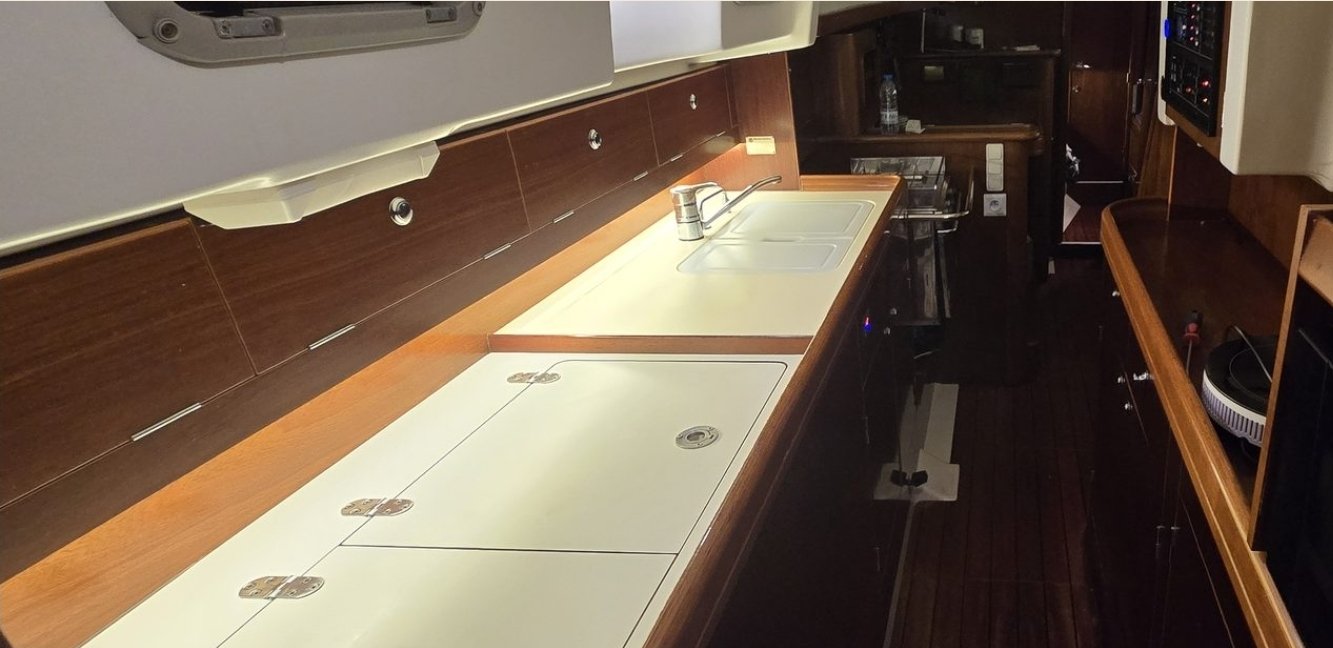
The Calma's galley, mahogany trim, stainless double sink
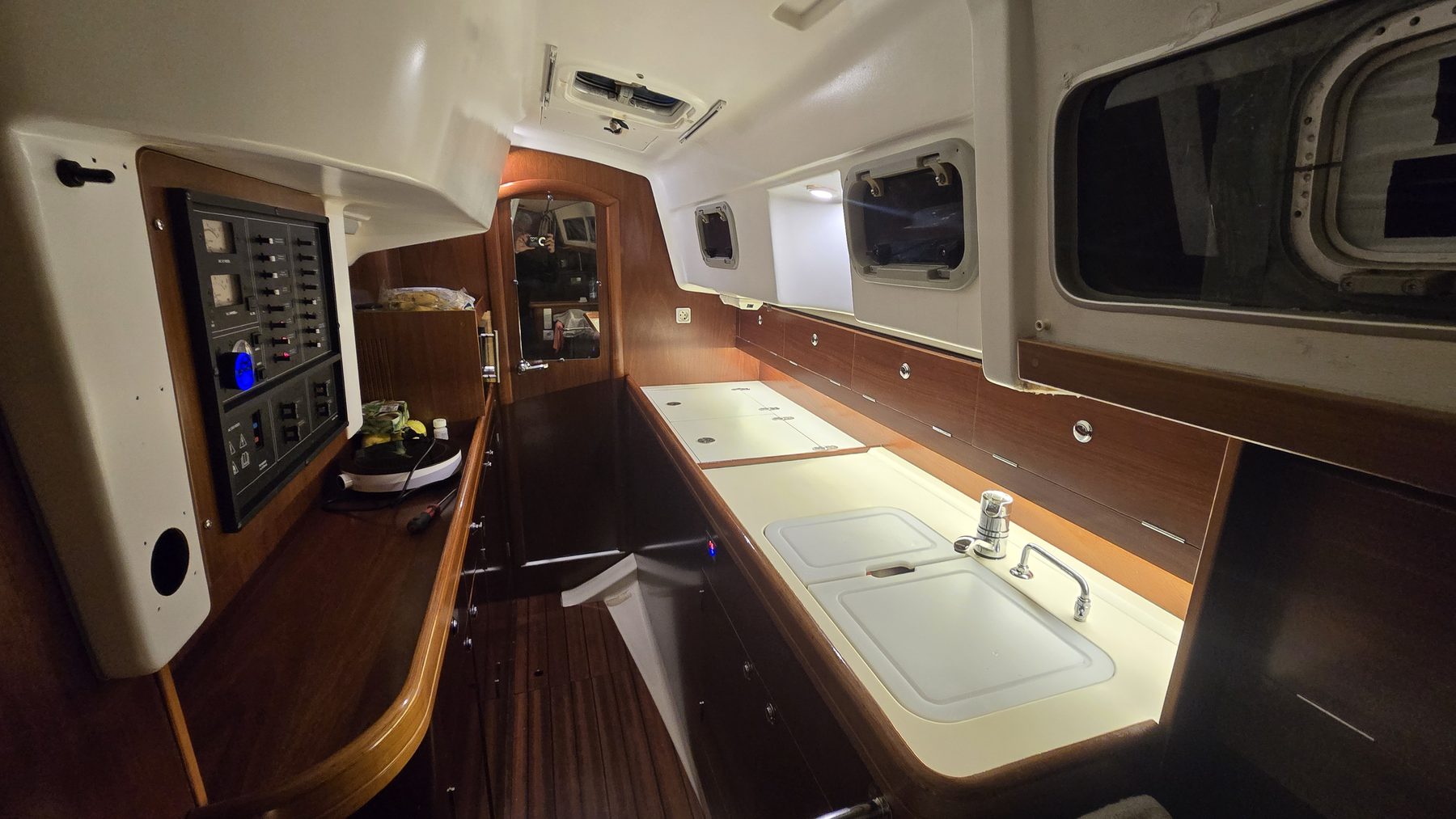
Galley

A real galley, not a kitchenette

Mahogany trim, generous countertop, stainless double sink, gimbaled propane stove, oven, compression fridge. Under-cabinet LED strip for late-arrival evenings. Built to cook for four without elbowing each other.

  • Cook 2-burner propane + oven
  • Cold Compression fridge
  • Sink Stainless double basin
The Calma's galley by night, view from the other end

The same galley, seen from the other end of the saloon, after dark.

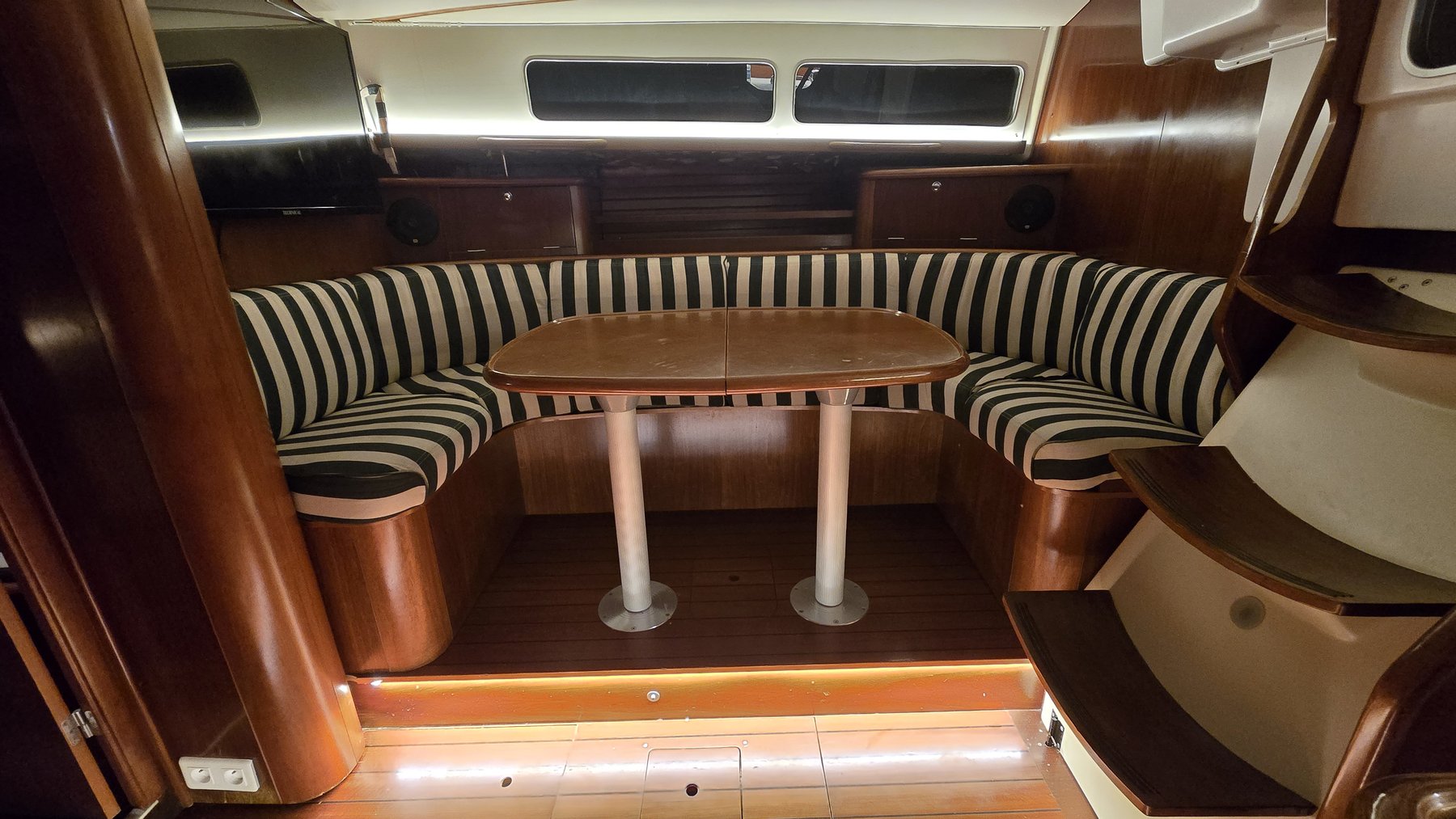
The Calma's saloon by night, U-shaped settee around the table, LED-lit
Saloon & nav station

The heart of life aboard

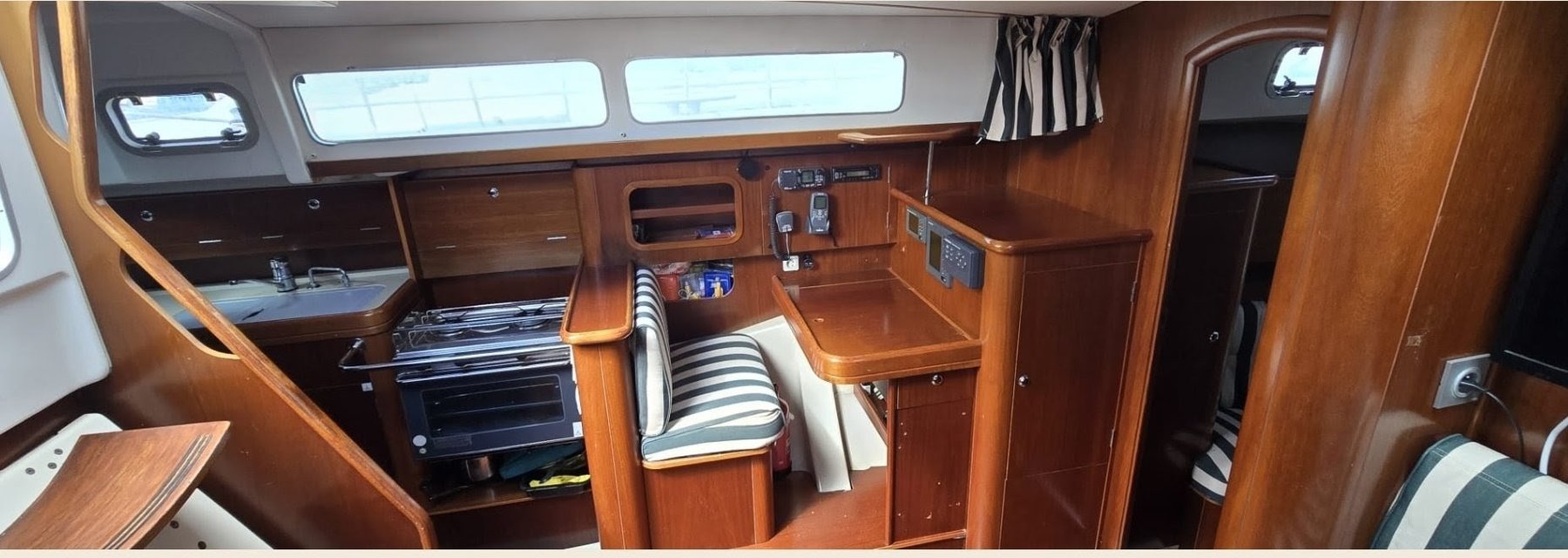
U-shaped settee around a fold-down table, comfortable for six. To port, the chart table with full instruments — VHF DSC, chart plotter, electrical panel. Side ports open="open" to the Catalan night.

  • Table Fold-down, seats 6
  • Nav Full chart table
  • Comfort Standing headroom
The Calma's chart table, instruments and electrical panel

The chart table to port — full instruments and electrical panel within sight.

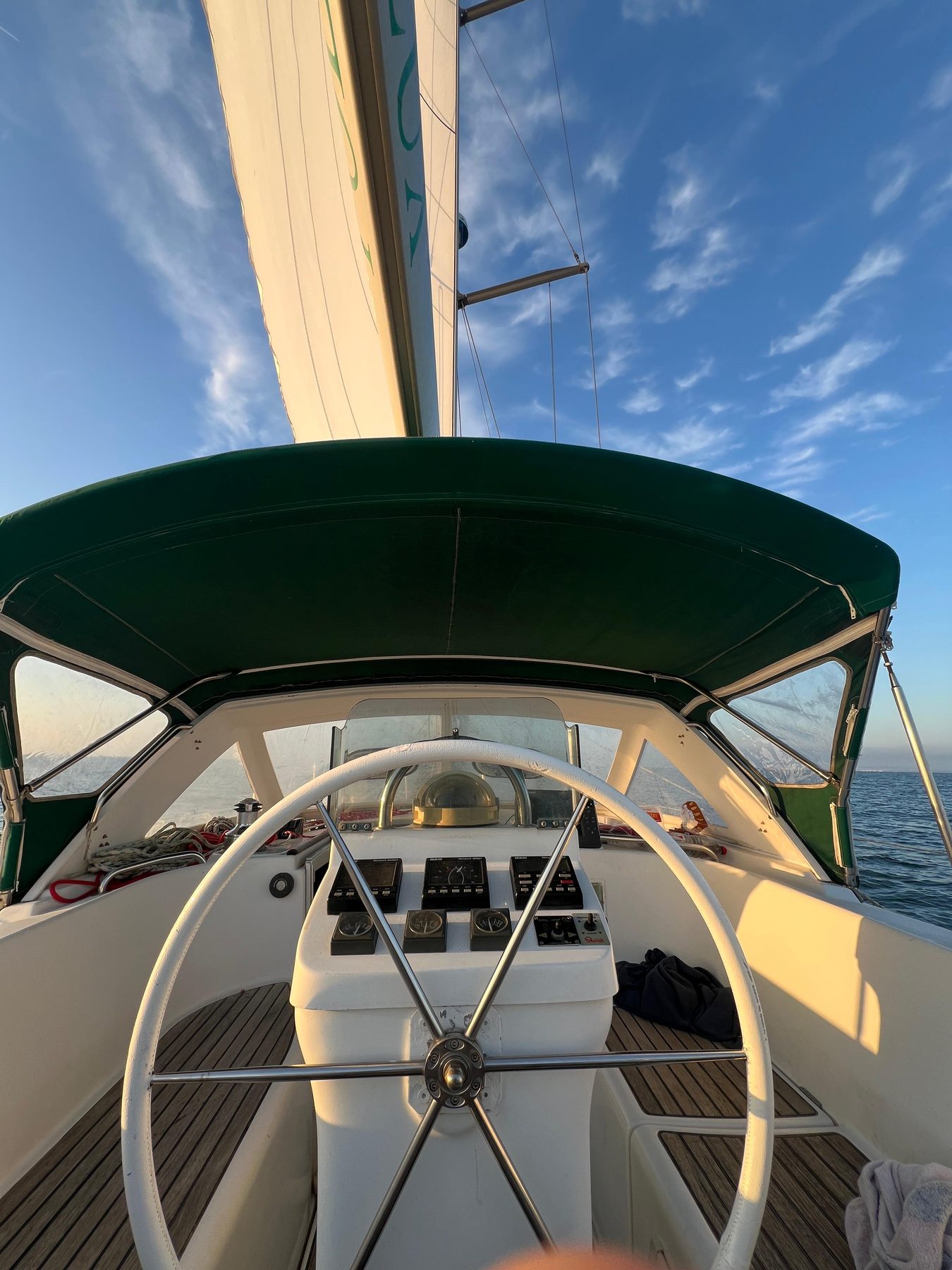
The Calma's center cockpit, wheel helm, green bimini
Cockpit

Everything at hand

Center cockpit, wheel helm, green bimini, U-shaped seating. From the helm column, you control the anchor windlass and the bow thruster — docking and anchoring made simple. Full electronics within sight: GPS/chart plotter, depth, wind, AIS, autopilot.

  • Anchor Helm-controlled windlass
  • Maneuver Bow thruster
  • Electronics GPS · AIS · autopilot
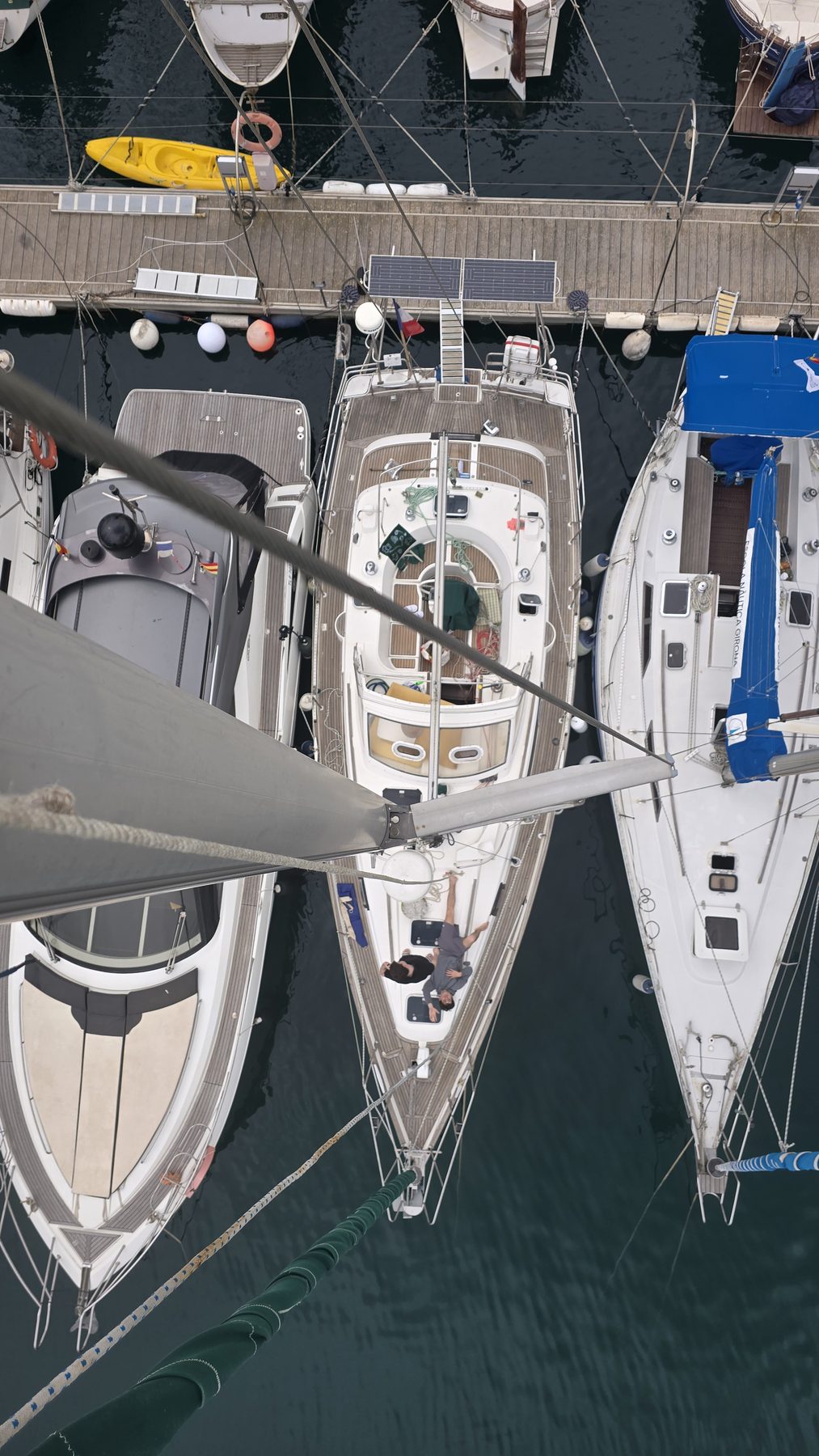
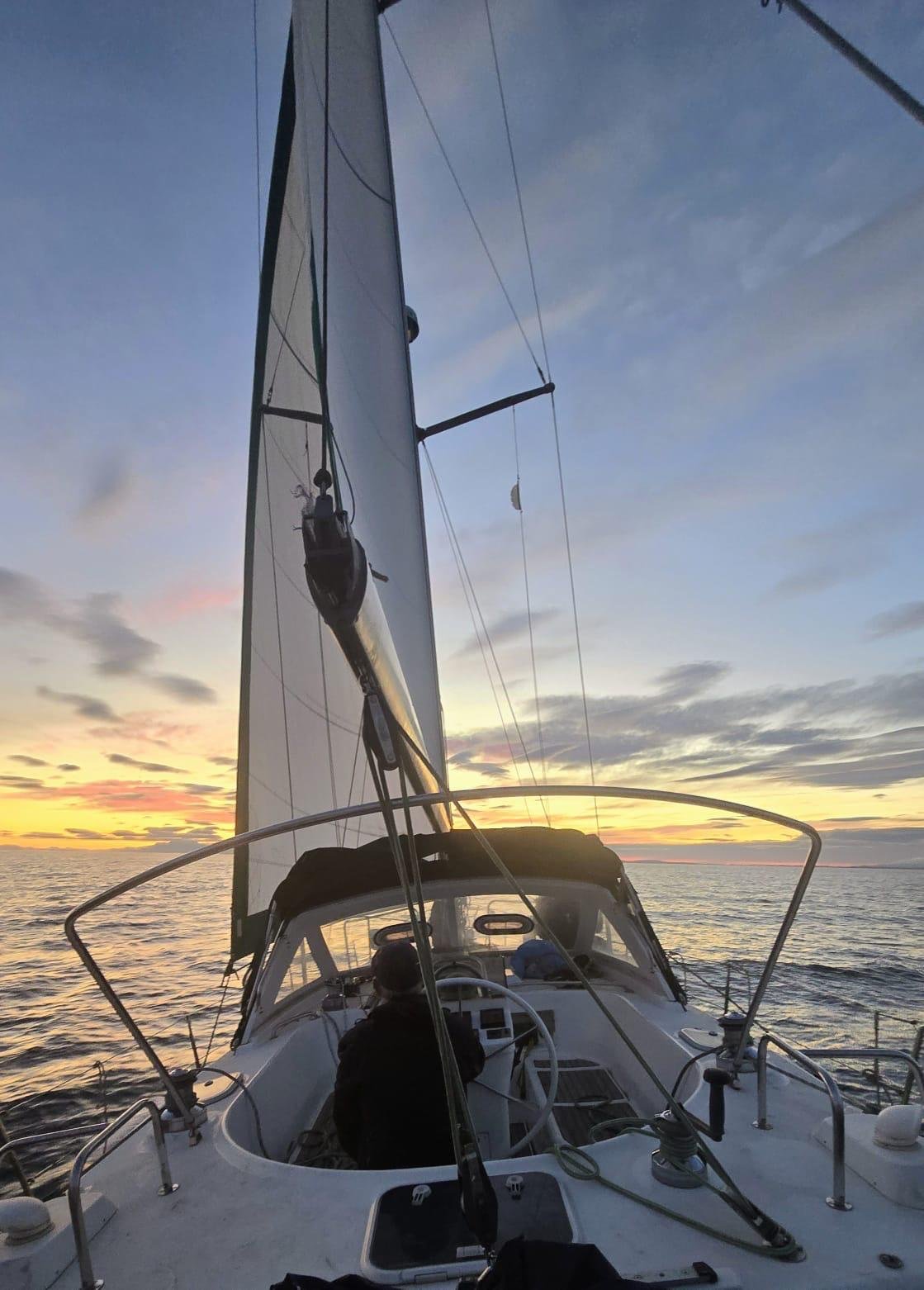
The Calma seen from the mast, deck and center cockpit

From the mast: a clear deck and the sheltered center cockpit.

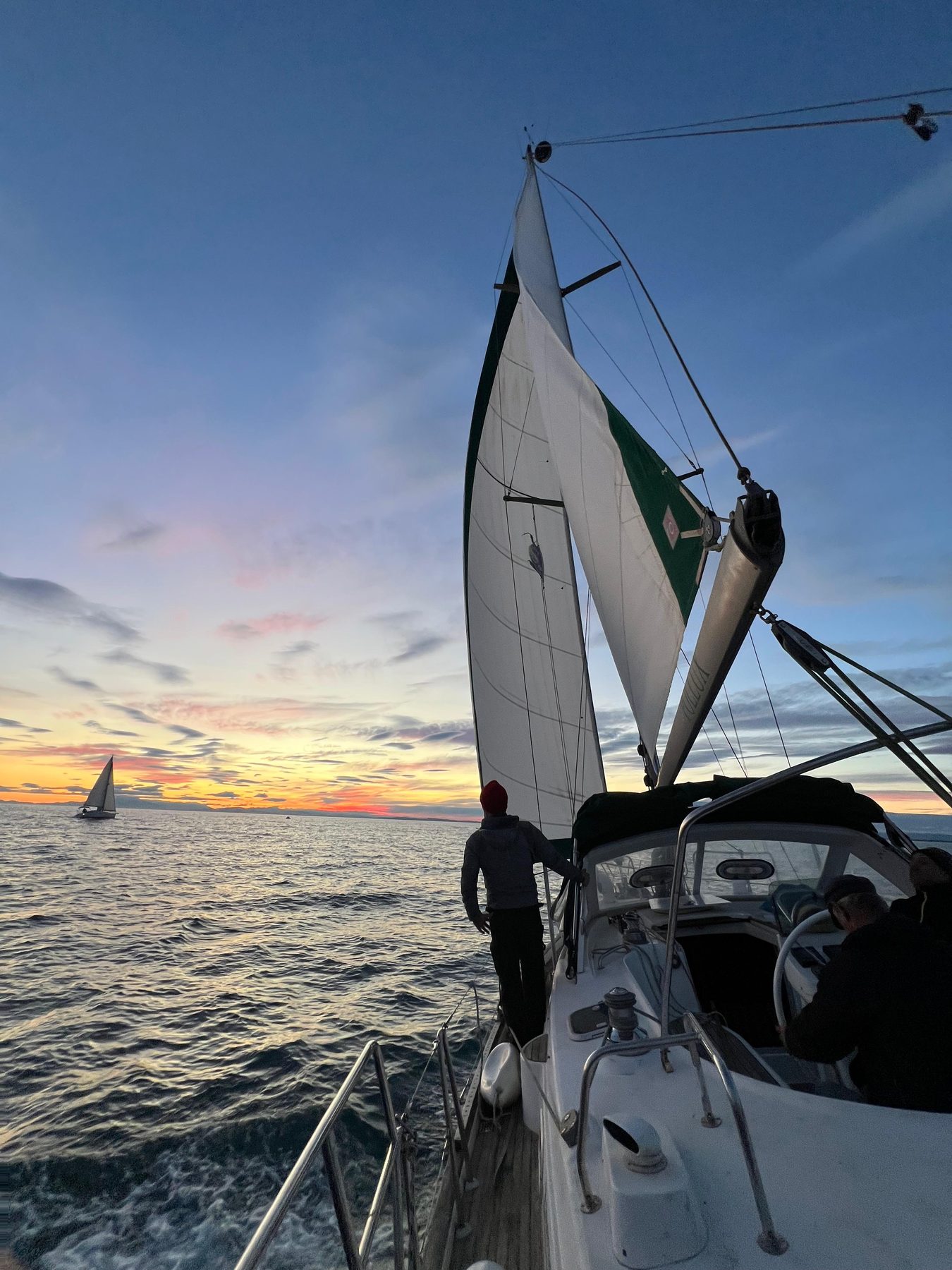
The Calma's bow and genoa under a sunset sky
Sails

Single-handed by design

In-mast furling mainsail — progressive deployment without going on the foredeck. Roller-furling genoa. Electric winch, and all lines led aft to the cockpit: one person can put her under sail.

  • Main In-mast furler
  • Genoa Roller furler · electric winch
  • Crew 1 person handles it
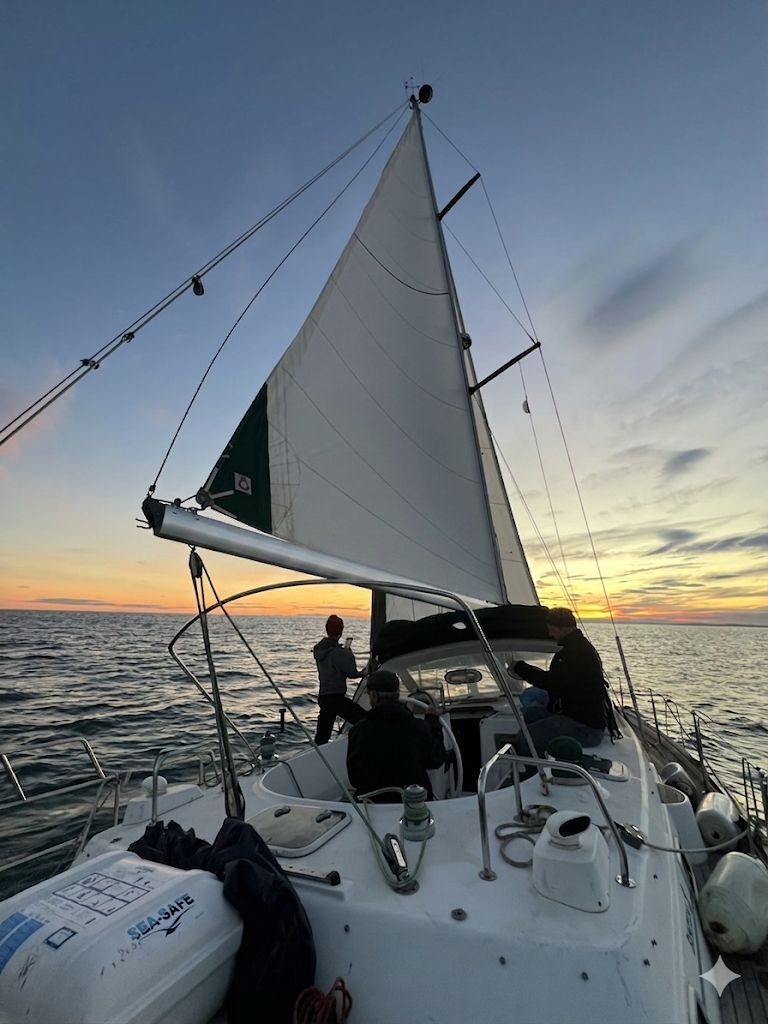
The Calma sailing at sunset, crew on board

Under sail at sunset — the crew relaxes, the boat sails herself.

— 03 / How it works

Simply.

CLUB CALMA is six couples who share one boat across the Mediterranean season, in a French legal framework. Four steps, no more.

i.

You apply

Online form, then a 30–45 minute phone call — informal, no commitment. A visit to Palamós to see the boat is welcome but never required; we can do it just as well over a video call if travel is inconvenient.

ii.

You pick your weeks

Founding season 2026 (June 1 – October 15): weeks are chosen at admission. From 2027 onward, a December video call lets each member pick their weeks for the next season — founders get first pick.

iii.

You sail

The boat is waiting in Palamós: fresh linens, full water and diesel, welcome basket. Over the season, members swap notes — by WhatsApp or in person — on anchorages, weather windows, restaurants. That's part of how the club works.

iv.

The annual review

In December, a 30-minute video call: how the season went, what's planned for next year, any feedback. Founding members have a voice in how the club evolves.

— 04 / Membership

A simple model, shared by six.

The club is built for couples who want to cruise around three full weeks per season, in well-cared-for conditions, at a meaningfully lower cost than chartering an equivalent boat for the same time. The financial details, calendar, and exact membership fee are shared with applicants after a first conversation.

The rhythm

Three weeks per season

Each member gets roughly three weeks of cruising per year, distributed by season profile. The calendar is set together, with a cap to keep summer balanced for everyone.

What's included

The house style

Mooring, insurance, maintenance, linens, personalized welcome, on-call concierge, full administrative handling. And a real club spirit, built up between members through the season.

The commitment

One season at a time

Annual membership. No co-ownership, no capital injection, no buy-in. Founding members of 2026 have first right of refusal on the next season — and the one after.

The full membership terms, calendar, and fee structure are sent in a dossier after a first conversation. We'd rather get to know our members before going any further.

Request the dossier
— 05 / How we host

The house style

Quiet attention, plus a club rhythm that builds up over the season among members.

  • Linens and a welcome basket on arrival — fresh sheets, bath and beach towels, kitchen towels, all laundered between members. Cava, fresh fruit, local charcuterie waiting at the chart table.
  • Boat ready, full of water and diesel — cleaned and checked="checked" between members, water and diesel topped up. The basics (coffee, salt, olive oil, vinegar, condiments) live on board year-round.
  • An on-call hand from the team — the concierge end of things, on WhatsApp during reasonable hours: weather routing, restaurant reservations, taxi to and from the airport, cleaning between weeks if you want it. We don't do everything for you — that's not the point — but we make sure nothing trips you up.
  • Independent skippers if you want one — we don't sell skipper services or take a cut. If you'd like a professional skipper for a day or for the whole week, we'll connect you to people we trust on the coast. You contract directly with them.
  • The club WhatsApp — over the season, members compare notes: anchorages they liked, restaurants worth the call, the small cala that nobody had told us about. It's optional but most members end up using it.
— 06 / Home port

Palamós, Costa Brava

A working Catalan sailing town — small, well-run, with a serious yacht club. Forty minutes from Girona airport, ninety minutes from Barcelona. The whole Costa Brava is within day-sail range; the Balearic Islands are an overnight passage away.

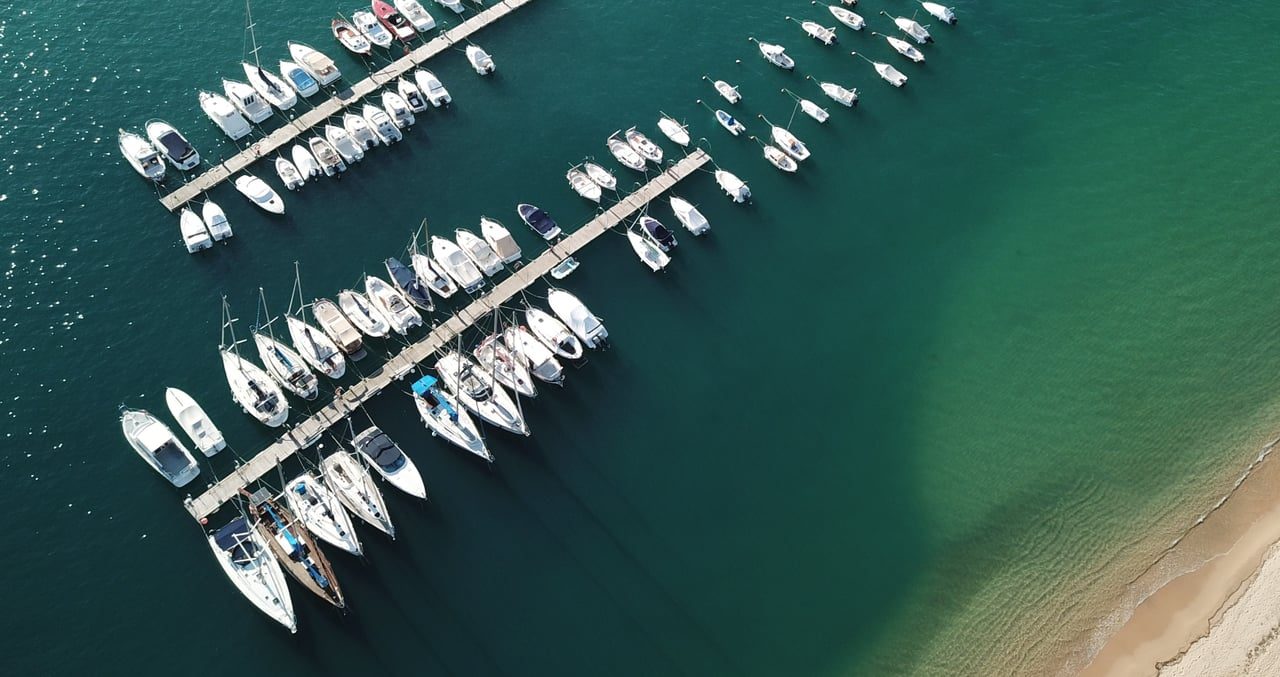
Aerial view of Club Nàutic Costa Brava in Palamós

Club Nàutic Costa Brava — Palamós · the floating docks from above.

Why Palamós

  • A real town that works year-round — daily fish market, Sunday street market, restaurants that stay open="open" through the off-season. A working maritime culture, not a resort.
  • A serious yacht club — Club Nàutic Costa Brava: dedicated berth, 24/7 capitanería, showers, fueling, on-site maintenance.
  • Strategic on the chart — gateway to the wild northern Costa Brava (Cap de Begur, Cadaqués, Cap de Creus) and a clean overnight to the Balearics (110 nautical miles).
  • Friendlier weather than the French coast — less Tramontane than the Languedoc, steadier than the Gulf of Lion. Sailing season is full June through mid-October.
— 07 / Sailing

Sailing the Costa Brava

The Costa Brava is, quietly, one of the most generous coastlines in the western Mediterranean for anyone who loves to sail: a reliable wind regime, dozens of coves, transparent water, and — the thing that surprises everyone — far less boat traffic in high season than the Côte d'Azur, Brittany or the Balearics.

The Garbí — the Costa Brava's thermal breeze

Through the warm season, the Costa Brava enjoys a remarkably steady thermal wind: the Garbí — the sea breeze that builds mid-morning and dies in the late afternoon. Catalan fishermen have known it forever, and the local saying captures it well: it rises when the sailboats leave the harbor, and goes to bed before dinner.

Typical strength: 10 to 25 knots, ideal for a 40-foot cruiser. Neither maddening calms nor storm-force gales. A clean, steady breeze that lets you cover real distances without forcing, sail enjoyable tacks, and be back at anchor in time for a swim. For the experienced Mediterranean sailor, it's about as good as it gets.

At dawn and in the early evening, the wind drops — those are the perfect hours for quiet anchoring, swimming, or motoring from one cove to the next.

The bay of Palamós is already a destination

A perfect day on the Calma doesn't require a long passage. Cast off mid-morning, slip out of the bay on the first puffs of Garbí, take an hour or two of sailing along the coast — turquoise water, pine cliffs. Drop the hook off Cala de la Fosca or further on toward Cala Margarida, swim, eat lunch on deck, nap under the bimini. Late afternoon, an easy run back to the mooring, shower on board, and dinner in one of the small restaurants of old Palamós — tapas, Costa Brava anchovies, local white wine. It's, in itself, one of the finest days you can give a sailboat.

And beyond, four postcard excursions

To the north — the Medes Islands. Two hours of sailing north, off L'Estartit. A protected marine reserve, one of the finest snorkeling and diving zones in the western Mediterranean. You swim among groupers, starfish, conger eels, sea bream, in water of stunning clarity. Mooring on regulated buoys (booking required), no fishing, perfectly organized. A day no one forgets.

Further north — Cadaqués & Cap de Creus. The end of the Catalan world. Cadaqués, the white village that inspired Dalí — accessible only by sea or mountain road. The stretch between Cadaqués and the Cap de Creus shows the most raw, mineral coastline of the Costa Brava, with coves few boats ever visit. Once you round the cape, you reach the French Côte Vermeille — Banyuls, Collioure, Port-Vendres — for those who want to push on.

To the south — Tossa and its calas. Ninety minutes of sailing south. Tossa de Mar with its medieval castle (the Vila Vella) plunging into the sea — one of the most photographed silhouettes on the coast. And around it, a string of remarkable coves: Cala Pola, Cala Giverola, Cala Llevadó, Cala Bona — turquoise water, sea-only access for most, sandy bottoms, pine forests dropping to the shore.

A week toward Barcelona. For those who want a different week: down from Palamós to Barcelona, and back. The Mediterranean of great cities — Sitges, Port Vell, the Olympic harbor. A few nights in town, tapas dinners, the contrast with the wild northern coves. A more urban itinerary, with favorable winds for the return.

From Palamós, the navigable range covers the entire Catalan coast and the French Roussillon: Blanes south (where the Costa Brava officially begins), Tossa, Sant Feliu, Calella de Palafrugell, Llafranc, Tamariu, Aiguablava, Sa Tuna, L'Estartit and the Medes, L'Escala, Cadaqués, Cap de Creus, Portbou. Across the border, the Côte Vermeille — Banyuls, Collioure, Port-Vendres, Argelès. Barcelona further south. Far more sea than anyone can explore in a single season.

A typical day, in high season

Coffee on board at first light, water still glassy. Cast off around nine and motor to a quiet cove — swim, snorkel, breakfast on deck. By eleven the Garbí comes in from the southeast: sails up, broad reach to the next stop. Anchor in early afternoon, nap, read, swim. Late afternoon, one last tack before the wind drops. Back to port for a shower, dinner at the village tapas place. It's a very simple rhythm, and it is exactly what makes this coast beautiful.

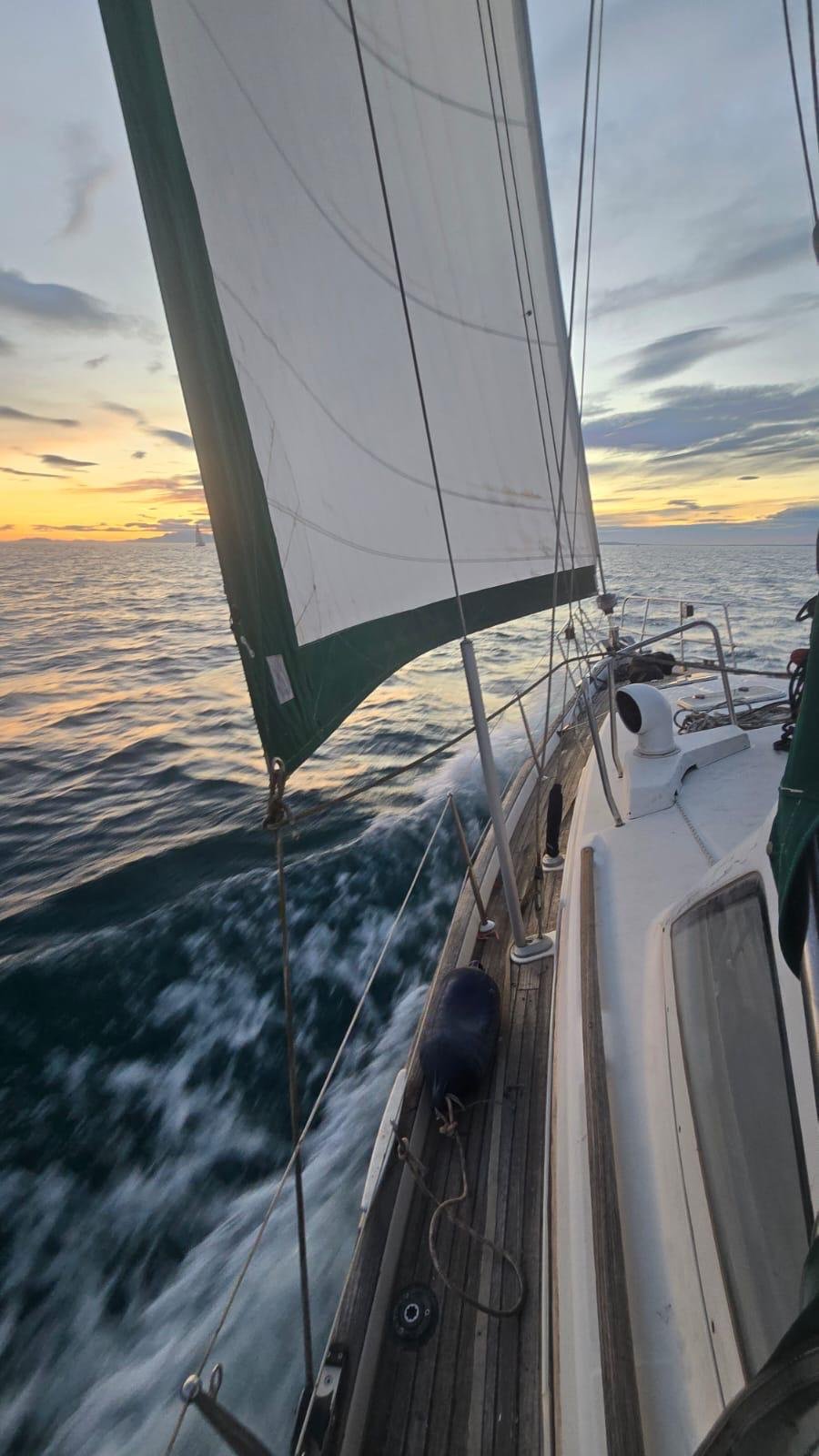
The Calma under sail at twilight, helmsman at the wheel
Under sail at sunset, wake along starboard rail
Under sail at sunset — last tacks before the wind drops.

And there's something nobody talks about: the Costa Brava is one of the least crowded coastlines for cruising in high season. Very few marina berths along an extraordinary coastal length. The result is simple: you drop anchor in crystalline coves, sometimes alone, sometimes with two or three other boats — where the same cove on the Côte d'Azur or the Balearics would be packed. One of the best-kept secrets in Mediterranean sailing.

Primary cruising ground: Costa Brava and the Roussillon coast (Banyuls to Blanes, Barcelona further south). The Balearics? Not yet — a possible evolution for future seasons, when both confidence and equipment have grown together.
— 08 / Story

The story of the Calma

This boat had a life before us, and we care about that.

First owner — twenty-two years of Mediterranean (1999–2021)

The Calma — under a different name then — left the Beneteau yard in 1999. Her first owner — a gentleman whose name we keep private out of discretion — kept her for twenty-two years and sailed her everywhere. When we bought her, we found charts on board from Turkey to the Balearics: Aegean, Adriatic, Ionian, Tyrrhenian, Gulf of Lion, Catalonia, the Balearic archipelago. The whole Mediterranean, slowly, methodically — the way you read a long book. He passed away about four years ago.

An interlude (2021–2024)

For a few years afterward, the boat stayed at the dock — first because of a long inheritance process, then because she was bought by a second owner whose illness derailed his plans. He sailed her very little. But he was a careful man, and the boat — though sitting still — had not been abandoned. She was loved, just not used.

Bringing her back (November 2025 → today)

I bought her last November, in Cap d'Agde. You could see she was a beautifully equipped boat coming out of several quiet years. Since then, hundreds of hours have gone into bringing her back to life — with affection, no excess, looking for original condition. Or better. Volvo MD22 (60 hp) overhauled by a professional mechanic, hatches restored, new gas installation, refitted galley, electronics rolling out, solar panels, deck shower, new life raft — and many smaller things.

Why this matters

We say it often: a boat that sleeps deteriorates. The Calma just came out of a period when she sailed very little, and she needed hands that would use her regularly. That's also why we open="open" the club. To sail is to maintain. And maybe, in some small way, to continue the patient work of her first owner — whose annotated charts still sleep in the chart table.

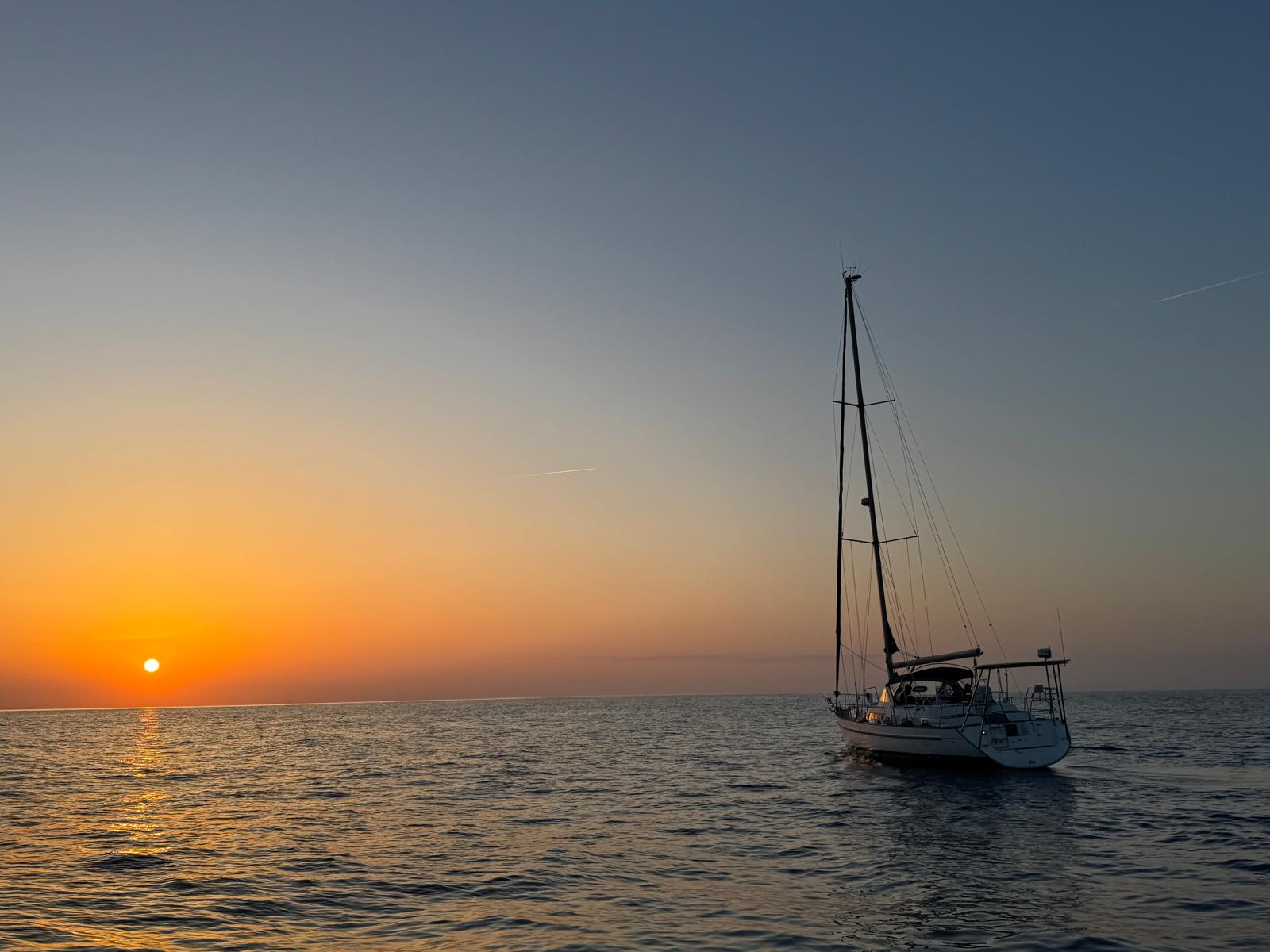
Sunset at anchor on the Costa Brava
"The whole Mediterranean, slowly, methodically — the way you read a long book."
— 09 / About us

Why the Calma, why a club

A boat I bought to keep

I've been sailing for several decades — half a dozen boats, an Atlantic crossing from Martinique to Horta, weeks crewing from Pisa to Nice and along the Spanish Cantabrian coast, charters with family in Greece, Croatia (my favorite), Sicily, Malta. Alongside the Calma, I keep a fifty-year-old Wayfarer dinghy I had restored in England — for the direct contact with wind — and a small motor launch for coastal family trips. Sail in all its forms, from dinghy to cruiser.

I bought the Calma last November in Cap d'Agde. She was a good boat that had been sitting for a few years — well kept, but quiet. I've put hundreds of hours into bringing her back, with affection, no excess: Volvo MD22 (60 hp) overhauled by a professional mechanic, hatches restored, new gas installation, refit galley, new electronics rolling out, solar panels, deck shower, new life raft — and many smaller things.

An American chapter, then a French one

I'm Spanish. After studying engineering in Spain, my wife and I went to the United States — first the East Coast for my MBA, then several years on the West Coast, in Seattle. Those were great years; they shaped how we work and how we receive guests. I started sailing seriously around 2001 at the Center for Wooden Boats on Lake Union — the volunteer-built, cedar-and-Sitka-spruce, learn-by-doing kind of place that quietly turns out good sailors. From Lake Union we got out into Puget Sound and up to the San Juan Islands: cold, pine-scented, weather-shaped sailing that ruins you for anywhere else. Until you discover the Mediterranean.

These days, work takes me to Miami too — a different planet, different water, but delicious in its own way. Calypso Instruments, the company I run, has a U.S. subsidiary with employees, customers, and suppliers; I'm in the States several weeks a year. I hold a U.S. visa. I work in English every day; my French is functional but earned.

Back in Europe, my wife and I built a family. Our two sons went through the French school system from kindergarten onward; both are now in university and bilingual French-English. We split our life between Spain, France (we keep an apartment in the Pyrenees), and the U.S. CLUB CALMA flies a French flag because it gives us — and our French members — the cleanest legal and tax framework: a French simplified joint-stock company, French invoices with French VAT, French contract law, a French point of contact. The hospitality, though, is genuinely tri-cultural.

Why a club, not a charter

I wanted the Calma to stay alive and well-kept, with her costs absorbed without strain — neither financial nor emotional. That's the club idea: six couples sharing access to a beautiful boat without owning it or having to look after it, and sharing a certain Mediterranean way of doing things — ideally for several seasons in a row.

The Calma was designed and configured as an owner's boat — Beneteau's "owner version": two real private cabins, two separate heads, volumes designed for cruising in couples. That's the structural difference, and it's what makes a six-person club make sense — instead of putting the boat into more open="open" circulation.

A club, for it to work, asks for something that doesn't fit on a contract. It's a mix of three things: being good hosts, being members of a club, and becoming friends. We're looking for experienced couples who share a love of the Mediterranean, who take care of things, and who enjoy meeting people from different backgrounds.

— Fernando Pascual-Andreu
President, CALMA S.A.S.U.

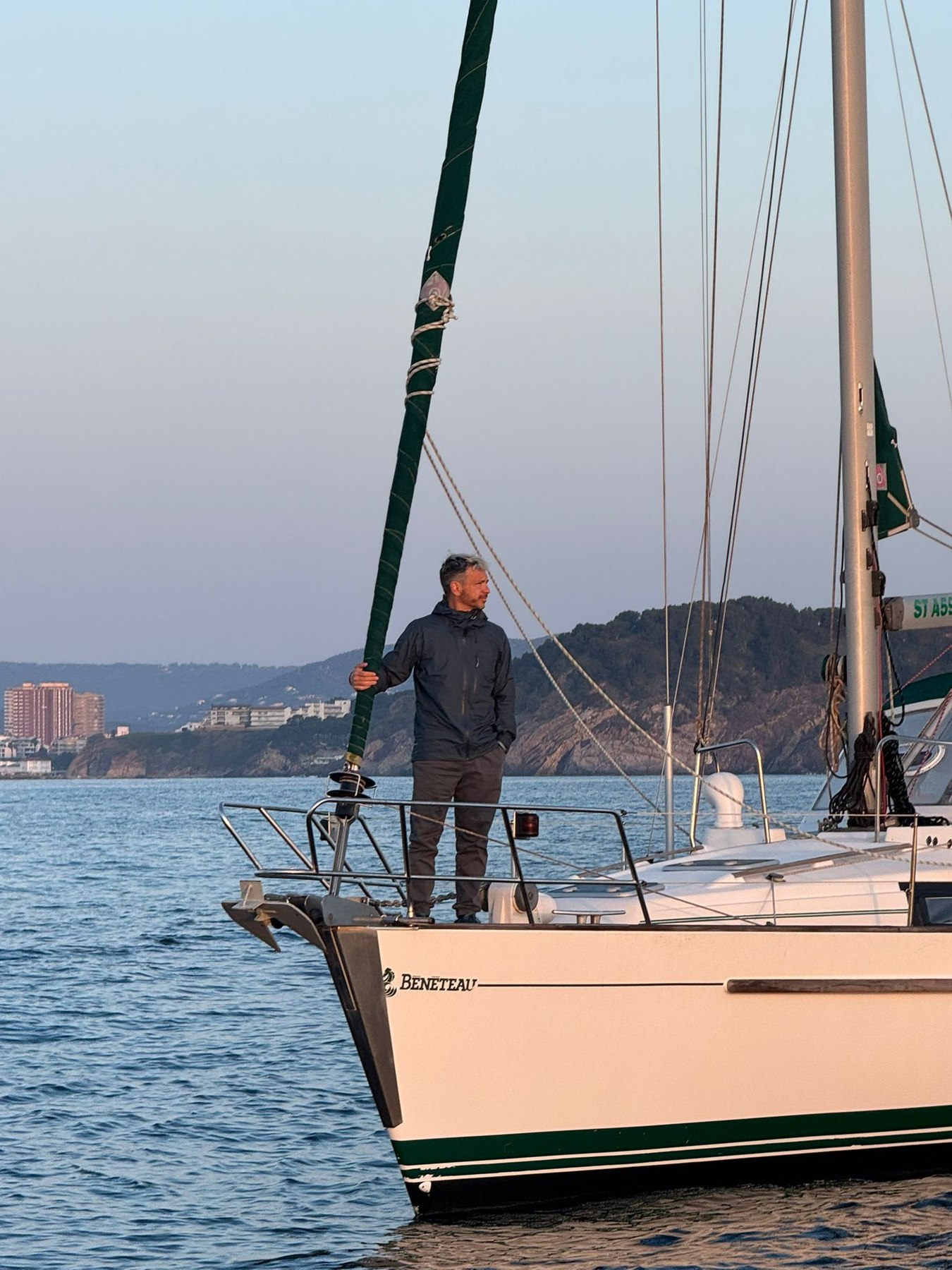
Fernando at the bow of the Calma at twilight off Palamós
At the bow at twilight, off Palamós. The boat makes it possible; the welcome is what we put under it.
— 10 / Frequently asked

A few quick answers

The deeper operational and financial detail lives in the dossier — sent after a first call. Below are the questions that come up before that.

Honest answer: structurally, no — it's a French sailing club. You don't book weeks like a hotel; you join for a season and your weeks are yours. The legal vehicle is a French simplified joint-stock company (S.A.S.U.) with a multirisk yacht insurance policy that includes the proper "rental without skipper" extension. Membership is annual.

That said, we don't pretend the day-to-day is unrecognizable to anyone who's chartered before: you arrive, the boat is ready, you sail, you give it back. What changes is the rhythm — the same six couples sailing the same boat over and over again, comparing notes, building a club spirit. That's not how charter works.

Best of both worlds. The Costa Brava offers cruising that's harder to find in Languedoc — wilder coastline, easier coves, world-class anchorages. By keeping the French flag, French registration, and French company, we stay in a clean legal and tax framework for our members: French invoices with French VAT, French contracts, French point of contact. You don't deal with any Spanish complexity.

Fair question, asked plainly: CALMA S.A.S.U. is recent, registered with the Paris Commercial Court in February 2026 (no. 101 663 904). The 2026 founding season is our first.

What backs it: the boat is owned outright, fully refit, registered with the French Maritime Administration, and insured under a proper multirisk yachting policy with the rental extension. Behind the company there are several decades of operational experience running international businesses with partners and clients across Europe, Asia, and the Americas. The company is recent; the discipline that runs it isn't.

Yes, genuinely. I lived several years in the United States (East Coast and Seattle), I work in English every day, my company has a U.S. subsidiary, and I'm in the States a few weeks every year. English is my working language. My French is functional but earned — I'd rather speak good English than awkward French.

The club is built around a French legal framework (that doesn't change), but the conversation, the WhatsApp threads, the welcome on the dock can absolutely be in English. The dossier and contract are available in English versions for convenience; the binding contract is the French one, by design.

The club spirit is built around cruising in couples — you, your spouse or partner, and the option to invite another couple or close family in the forward cabin. Two to four people on board is the comfort sweet spot.

Guests are under your responsibility (covered in the contract). Kids welcome. No subletting and no commercial use — but a friend's family for a week is exactly what the second cabin is built for.

— 11 / Apply

Request an introduction

6 founding seats · 2026 season

We read every application personally. We respond within 5 business days to schedule a phone call.

We use this number for calls, SMS or WhatsApp — whichever works for you.